
Studio Lighting Color Temperature: How to Choose 3200K vs 5600K
Why traditional studios settled on 3200K, why LED-era studios often choose 5600K, where 4000K–5000K fits, and how to specify an adjustable LED panel without being misled by the numbers on the box.
In this guide
1. What color temperature actually measures
Color temperature describes how warm or cool a light source appears, measured in kelvin (K). The scale comes from the theoretical blackbody radiator: heat an ideal object and it glows red, then orange, then white, then blue-white as temperature rises. Lower kelvin values therefore look warmer and higher values look cooler — the opposite of the everyday intuition that a higher number means a hotter light.
Most studio fixtures are not true blackbody emitters, so the correct term is correlated color temperature (CCT): the blackbody temperature whose appearance most closely matches the source. This is why a datasheet says "CCT" rather than "color temperature".
| Approximate CCT | Appearance | Typical source |
|---|---|---|
| 2000K–2700K | Very warm, amber | Candlelight, warm practicals, vintage tungsten look |
| 3000K–3200K | Warm white | Tungsten and halogen studio fixtures |
| 4000K–4500K | Neutral white | Mixed environments, some LED panels |
| 5000K–5600K | Daylight white | HMI, daylight LED, overcast daylight |
| 6000K–6500K | Cool white | Overcast sky, some LED panels |
| 10000K+ | Blue | Open shade, blue-hour sky |
The ranges are indicative. Perceived color also depends on the display, the surrounding light and the camera's white balance.
Three things color temperature is not
- Not brightness. Brightness is set by illuminance (lux), not kelvin. A 3200K fixture can be brighter than a 5600K fixture.
- Not softness. Softness comes from the size of the emitting surface relative to the subject, and from distance and diffusion — not from CCT.
- Not color accuracy. Two fixtures at the same CCT can render skin completely differently. That is a function of spectrum and color rendering, covered in section 7.
2. 3200K: the tungsten-era standard
3200K became the reference for film and television because tungsten-halogen lamps, run at their rated voltage, sit very close to that value. When an entire studio is lit at 3200K and the camera is balanced to 3200K, white objects render white and skin tones look natural — the image does not "come out yellow". The warmth only becomes visible when the camera is balanced for a different temperature.
- Existing inventory. Studios with tungsten or halogen fixtures can add LED panels matched to 3200K and keep one consistent white point.
- Look. Warm white is flattering for interviews, talk formats and narrative interiors.
- Predictability. Tungsten is a continuous blackbody source, so its spectrum is straightforward for cameras to render.
Typical use: traditional television studios, interview and talk shows, interior drama, warm-toned productions.
3. 5600K: the daylight LED standard
5600K approximates daylight and became the default for LED-era studios for practical reasons rather than stylistic ones.
- It matches daylight. A studio with windows, or a shoot that intercuts with exterior footage, has far less work to do if the interior reference is already daylight.
- It suits modern set design. News studios built around white, grey and blue elements read more cleanly under daylight-balanced light.
- It simplifies mixed LED rigs. Panels, fresnels and moving lights specified at 5600K are easier to keep consistent.
Bi-color LED panels typically switch between 3200K and 5600K, which covers both conventions without changing fixtures.
4. 4000K–5000K: the flexible middle
Neutral white sits between the two conventions and is common in converged spaces — a room that hosts a news desk, an interview corner and a social-media shooting area, often with architectural lighting and decorative fixtures in the same shot.
The advantage is diplomatic: a neutral reference is less likely to clash with whatever ambient light already exists. A lighting director can nudge key and fill toward the room instead of fighting it.
The trap is assuming that setting every fixture to 4500K solves mixed lighting. It does not. Two fixtures from different manufacturers, both set to 4500K, can still differ in green–magenta balance and in spectral content, producing skin that reads slightly green on one camera and slightly magenta on another. Neutral CCT reduces the visible clash; it does not remove the need to match and calibrate.
5. Why wide-range LED fixtures became popular
Older studio fixtures were fixed: a tungsten fresnel was 3200K, an HMI was roughly 5600K. LED panels changed that, and adjustable CCT is now common.
| Range | What it covers |
|---|---|
| 3200K–5600K | The two classic production references |
| 2700K–6500K | Warm practical looks through daylight |
| 2800K–10000K | Wider creative range, including cool effects |
| 2000K–20000K | Full-color fixtures with extended CCT control |
These are design ranges offered by different products, not a statement that every fixture performs equally across its range.
The practical benefits are real:
- One fixture, several jobs. A panel can serve as a 3200K key light on Monday and a 5600K daylight fill on Tuesday.
- Program flexibility. News wants clean and neutral; interviews often want warmth; entertainment wants contrast. Adjustable CCT gives the lighting director room to work.
- Easier matching. When ambient and decorative light are already present, adjustable fixtures can be moved toward the room instead of fighting it.
- Less pressure in post. Getting white balance consistent on set reduces the color work needed to match multiple cameras later.
6. Choosing a reference CCT by studio type
| Studio type | Suggested reference | Why |
|---|---|---|
| News studio | 3200K or 5600K | Priority is accurate skin and multi-camera consistency. Pick whichever matches the existing rig and set design, then hold it. |
| Interview / talk show | 3200K–4500K | Warmth supports intimacy. Start near 3200K, then shape with soft key light and controlled contrast rather than with color alone. |
| Converged / streaming studio | 4000K–5600K | One room, several formats. Adjustable panels let the same rig serve news, interview and product segments. |
| Virtual studio / green screen | 3200K or 5600K, held constant | Consistency, even green-screen illuminance and separation of subject from background matter more than the number itself. LED volumes need dedicated color matching. |
These are starting points for lighting design, not industry mandates. The correct value depends on the camera system, the ambient light, the set materials and the program.
7. Three principles that matter more than the number
Principle 1 — Keep key and fill color-coordinated
In conventional portrait lighting, key and fill should share a white point. If the key is 5600K, bring the fill to 5600K and create dimension with intensity ratio, not with a color shift the viewer cannot explain.
Deliberate warm/cool separation is a valid creative choice — a warm key against a cool rim, for example. The distinction is intent versus accident. If the audience reads it as a mistake, it is a mistake.
Principle 2 — Balance the camera to the light, not the menu to the number
Setting the camera to 3200K in a 3200K studio is the correct starting point, and the same applies at 5600K. But for critical work, typing the same number into the menu is not enough.
- Use a grey card, white card or color chart under the actual lighting.
- Check camera-to-camera consistency on multi-camera shoots; two bodies of the same model can differ.
- Re-check after changing fixtures, dimming levels or diffusion — dimming can shift CCT on some LED fixtures.
Principle 3 — Color rendering is as important as CCT
Two fixtures at 5600K can render a face very differently. When specifying studio panels, look past the CCT range.
| Metric | What it tells you | Watch for |
|---|---|---|
| CRI (Ra) | Average fidelity across eight test colors | An average can hide a weak red. Ask for R9 separately. |
| R9 | Saturated red rendering | Directly affects skin, lips and warm fabrics. Low R9 makes faces look flat or grey. |
| TLCI | Broadcast-oriented rendering index | More relevant to television than CRI alone. |
| SSI | Spectral similarity to a reference source | Useful when matching LED to tungsten or daylight. |
| Duv | Distance from the blackbody locus | Positive Duv reads green, negative reads magenta. Small differences become visible when fixtures are mixed. |
For skin-critical work, test with the actual camera rather than trusting a datasheet alone.
8. Is a wider CCT range better?
No — and the assumption leads buyers astray. What matters is whether the fixture delivers stable, high-quality light at the temperatures you will actually use.
A panel rated 2700K–6500K that is accurate, bright and consistent at 3200K and 5600K will serve most studios well. A panel that reaches 10000K but drifts in color, loses output or fails to match its siblings at common settings is the weaker tool, regardless of the number on the box.
Checks before ordering
- Ask for measured illuminance at 3200K, 4300K and 5600K — not just maximum output.
- Ask for CRI, R9 and TLCI at those same settings. Many datasheets quote the best-case value only.
- Ask about output change across the range. Bi-color mixing often costs brightness at the extremes.
- Test two units side by side. Fleet consistency matters more than a single demo unit.
- Confirm control. DMX512, wireless DMX, green/magenta correction and preset recall are what make a wide range usable on a busy schedule.
9. LED soft panels for studio work
The panels below are built for camera-facing environments — studios, interviews, broadcast desks and conference rooms. Specifications are taken from the linked product pages; confirm the exact CCT range, measured output and color-rendering data in the quotation.
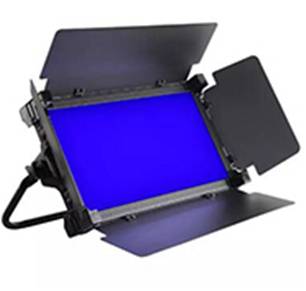
Powerful 400W RGBWW Studio Panel
High-output RGBWW soft panel for studio key light, broadcast desks and film production.
View product →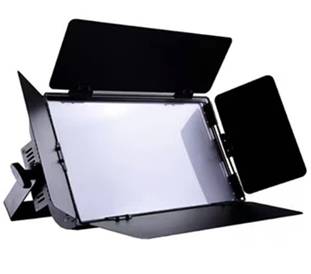
LED Video / Film / TV Flat Panel 200W
200W flat panel for professional studio and broadcast lighting with soft, even output.
View product →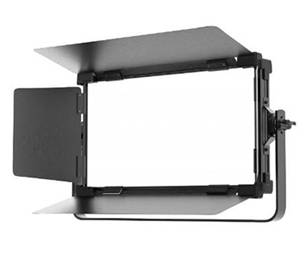
Colorful RGBWA 5-in-1 Video Panel
RGBWA 5-in-1 panel for color effects and high-CRI studio lighting.
View product →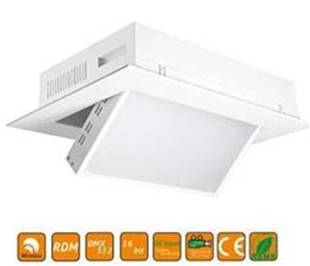
Embedded Flip Panel Light
Motorized flip panel for conference rooms and studios where the fixture stows into the ceiling.
View product →Browse the full LED soft panel range →
10. Where studio lighting is heading
Studio lighting has moved from fixed-temperature fixtures toward managed color: adjustable CCT, green/magenta trim, DMX and wireless control, and recallable presets. On a large stage, a lighting console can change an entire program's look between segments without swapping equipment.
What has not changed is the requirement underneath:
- Color accuracy — skin and product render truthfully.
- Output stability — the same setting produces the same result all day.
- Consistency — every fixture in the rig agrees with the others.
3200K still produces natural, believable pictures. So does 5600K. Neither is inherently superior; the question is whether the fixtures, the camera and the set design share one coherent reference. For a new build or a refurbishment, the sensible sequence is: choose the reference CCT from the program and the room, specify fixtures that perform well at that CCT, and verify the whole system with a color chart under show lighting before the first recording.
11. Frequently asked questions
Is 3200K or 5600K better for a studio?
Neither is inherently better. 3200K matches existing tungsten or halogen inventory and gives a warmer, more intimate look. 5600K matches daylight, suits modern sets with white and blue elements, and simplifies mixed LED rigs. Pick the reference that fits your camera, set and ambient light, then hold it across the studio.
Can I mix 3200K and 5600K fixtures in one studio?
You can, but only deliberately. Mixing requires that each camera is balanced for the dominant source and that the difference is either corrected with gels or used as a creative contrast. Undisciplined mixing produces skin that shifts between cameras and shots that cannot be matched in post.
What is the difference between CCT and color temperature?
Color temperature describes a true blackbody radiator. Most LED fixtures are not blackbody emitters, so their value is a correlated color temperature (CCT): the blackbody temperature whose appearance most closely matches the source. Two fixtures can share a CCT and still have different spectra.
Does a wider CCT range mean a better LED panel?
No. What matters is output, color rendering and consistency at the temperatures you actually use. Ask for measured illuminance and CRI/R9 data at 3200K, 4300K and 5600K rather than judging by the widest advertised range.
What CRI do I need for studio lighting?
Look for high CRI together with a separately quoted R9 value, because the Ra average can hide weak red rendering. For broadcast work, also ask for TLCI. For skin-critical productions, verify with the actual camera under show lighting rather than relying on the datasheet alone.
Why do my LED panels look green or magenta when mixed?
This is usually a difference in Duv, the distance from the blackbody locus, rather than in CCT. Panels set to the same kelvin can sit slightly above or below the locus. Look for fixtures with green/magenta trim, and check the tint values when matching brands.
What color temperature should I use for a green screen or virtual studio?
Choose 3200K or 5600K and keep it constant across the whole rig. On a green screen, even illuminance across the screen, separation between subject and background, and consistency between cameras matter more than the specific value. LED volumes require dedicated color matching between the screen and the lighting.
How should I set camera white balance for studio lighting?
Start from the nominal value — 3200K in a tungsten studio, 5600K in a daylight studio — then refine with a grey card, white card or color chart under the actual lighting. On multi-camera shoots, check each camera individually and compare them before recording.
12. Next step
If you are specifying or upgrading a studio, send the program types, room dimensions, existing fixtures, camera system and target look. The engineering team can review the reference CCT, panel mix and color-rendering requirements, and prepare a project-specific quotation.